The Becker Collection
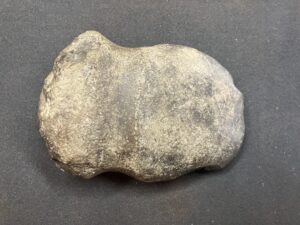
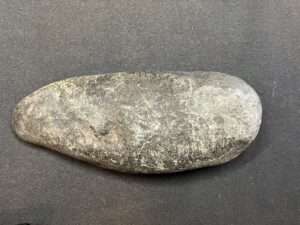
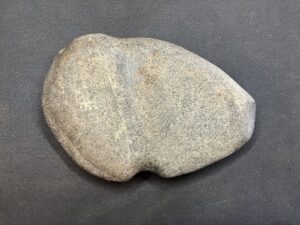
The three axe heads in the Monee Historical Society collection were found on the Becker farm in rural Monee Township.
 Augustus Becker received a land grant from President Franklin Pierce in 1854 of 167 acres located west of Kuersten Road and south of Pauling Road.  The land remained in the Becker family for over a century, being passed down to sons Sylvester and Leslie before being sold to the Duetsche family.  The artifacts came to light during the early years of farming when teams of horses did the plowing while the farmers walking behind were close enough to the earth to see what was being turned up by the plough blades.
Grandma Becker told stories of how she remembers the native families returning to the land every fall for many years and camping there for a week or two as they visited the graves of their ancestors who were buried there.
Axeheads

Early Indian (Native American) axe heads, found during the Archaic period (c. 9000-2,700 years BP), were primarily ground stone tools, with the earliest being the full-grooved axe. These stone heads were skillfully ground, polished, and then attached (hafted) to wooden handles to create essential tools for chopping wood or crushing food. Later developments included three-quarter-grooved and half-grooved forms, with the latter being rarer, indicating an evolution away from full grooves.


Evolution of Groove Forms:

    •    Full-Grooved Axe: The earliest form of ground stone axe, characterized by a groove that encircles the entire head.
    •    Three-Quarter-Grooved Axe: Developed later than the full-groove, this form is the most numerous of all axe types.
    •    Half-Grooved Axe: The rarest form, signifying a move away from fully grooved designs.
Materials and Manufacturing:
    •    Early axe heads were made from dense, fine-grained stones.

    •    They were skillfully ground and polished to a smooth, sharp edge.

    •    Chipping was also used, as seen with the "Guilford Axes" from North Carolina during the Middle Archaic period.

Usage:
    •    These stone axes were hafted onto wooden handles, forming a critical tool for daily life.

    •    They were used for various tasks, including woodworking and crushing food.

Significance:

    •    The craftsmanship of these early axe heads reflects the technological innovation and resourcefulness of Indigenous peoples.
    •    The tools represent a long-standing technology that remained largely unchanged in form and function for thousands of years across North America
Artifact Details


